For self-employed individuals, freelancers, and small business owners in Malaysia, medical insurance is a very important safety net—because it covers downside risks of medical emergencies very well. Unlike individuals who have normal, every day jobs – you do not get paid sick leave. Falling sick also takes you out of your work 99 percent of the time (unless except if your business is already very well set up, and can run without your input – of course this is very rare for SME businesses for sure), translating into a loss of income.
The following guide breaks down your best medical insurance options for the year of 2026, structured by your business size. We encourage small and medium sized business owners, freelancers such as Grab drivers/riders and photographers and self employed individuals to read this article, so that a suitable medical protection policy can be setup from the ground up to provide solid medical coverage for you in the year of 2026.
What’s the Most Essential Medical Coverage for Self Employed Individuals?
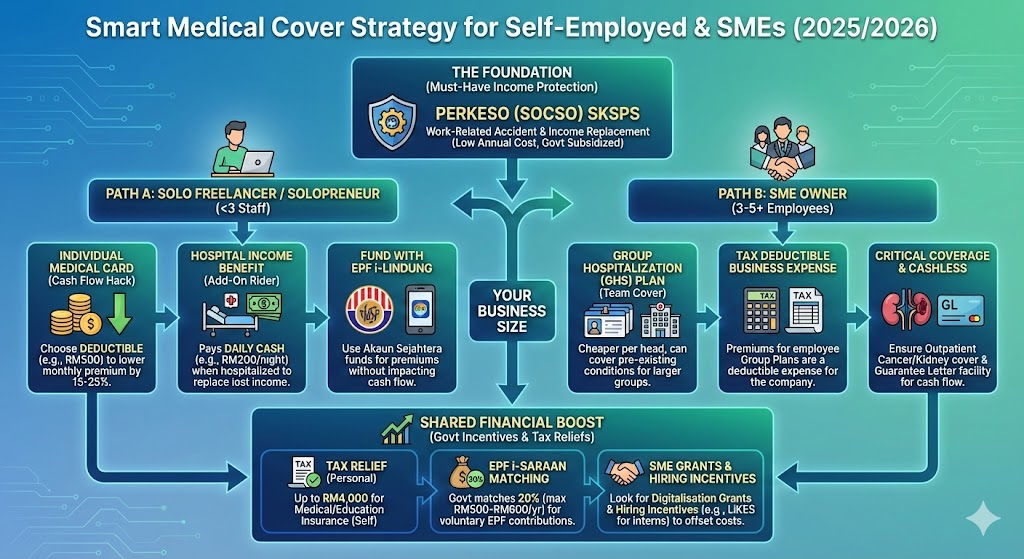
First of all, before looking at private insurers, you must secure the Government-backed protection. It is the single cheapest and most effective financial floor you can build.
- Have a look at PERKESO (SOCSO) Self-Employment Social Security Scheme (SKSPS):
- What it is: Covers medical costs, temporary disablement (medical leave wages), and permanent disability for work-related injuries or accidents (e.g., getting into a car accident while meeting a client).
- Cost: Extremely affordable (Plan 2 is ~RM232.80 per year).
- Why you need it: Private medical cards often exclude “occupational hazards.” SKSPS fills that gap.
- Action: Register immediately at Perkeso.
Insurance Cost for Perkeso’s Self Employed Social Security Scheme:
This is taken straight from Perkeso’s website. It is refreshing that a good level of insurance coverage can be obtained by self employed individuals and small business owners at a very reasonable cost.
| Bil. | Pendapatan Bulanan | Bayaran Caruman Bulanan | Bayaran Caruman Setahun |
|---|---|---|---|
| 1 | RM1,050 | RM13.10 | RM157.20 |
| 2 | RM1,550 | RM19.40 | RM232.80 |
| 3 | RM2,950 | RM36.90 | RM442.80 |
| 4 | RM3,950 | RM49.40 | RM592.80 |
On top of medical coverage, you also get protection against temporary and permanent disabilities. Permanent disability allows you to claim 90 percent of the income level that you’re at.
From Perkeso’s website:
Contoh pengiraan Faedah Hilang Upaya Kekal (bayaran pukal) jika taksiran sama dengan 20% dengan faktor umur 8873 (umur bawah 20 tahun) dan kadar caruman RM592.80.
= (RM3,950 X 90% ÷ 30 hari) X 20% X 8873
= RM210,290.10
If you pay a yearly insurance cost of RM 592.80 and suffer from permanent disability, you are eligible to get a compensation of RM 3950 x 90 percent divided by 30 days x 20 percent x 8873 (actuarial age factor) meaning a 20 year old is then compensated with RM 210,290.10 if he/she suffers from permanent disability at work.
| Umur Semasa Bencana (Tahun) | Faktor Aktuari (Nilai) |
| Di Bawah 20 | 8873 (atau 8973 bagi jadual terkini 2024) |
| 20 hingga < 25 | 8530 |
| 25 hingga < 30 | 8029 |
| 30 hingga < 35 | 7479 |
| 35 hingga < 40 | 6876 |
| 40 hingga < 45 | 6221 |
| 45 hingga < 50 | 5538 |
| 50 hingga < 55 | 4880 |
| 55 hingga < 60 | 4238 |
By plugging in your age’s factor, you’re then able to find out how much disability payout you’re eligible to get from Perkeso’s disability payout. This is a very nice add on, while we’re on the topic of medical insurance for sure.
Read more about Perkeso’s self employed insurance scheme here:
https://www.perkeso.gov.my/perkhidmatan-kami/perlindungan/pekerjaan-sendiri.html
Get started here: https://prihatin.perkeso.gov.my/
Best Medical Card for The Solo Freelancer / Solopreneur
Assumption: You work alone or have fewer than 3 employees. You generally cannot buy “Group SME” insurance and must purchase an Individual Medical Card.
Top Recommended Plans
For self-employed individuals, the key is to protect your cash flow. To save on your monthly medical insurance premiums, I recommend plans with a Deductible option.
- Strategy: Choose a plan with a RM300 – RM500 deductible (amount you pay before insurance kicks in). This can effective lower your monthly premium by 15-25%.
If you contribute to EPF (KWSP) voluntarily (i-Saraan):
- You can use funds from your EPF Account 2 (Akaun Sejahtera) to pay for medical insurance for yourself and your immediate family.
- Benefit: You don’t use your monthly business cash flow to pay premiums.
- How: Log in to the KWSP i-Akaun app and look for the “i-Lindung” section to buy plans from Prudential, Etiqa, FWD, etc.
The Small Business Owner (SME)
You have at least 3 to 5 full-time employees.
If you have a team, you can transition from individual plans to Group Hospitalization & Surgical (GHS) plans. These are cheaper per head and often cover pre-existing conditions for staff (if the group size is large enough).
- Minimum Requirement: Most insurers (AIA, Allianz) require a minimum of 5 employees to start a Group plan. If you have 3-4, you may need to stick to individual plans or look for “Micro-SME” pools.
Tax Advantage: As a business owner, premiums paid for Group Employee Insurance are generally a tax-deductible business expense. (Note: Insurance for yourself as a Sole Proprietor is a personal expense, not a business deduction, though you get personal tax relief).
Summary of Costs & Tax Reliefs
When calculating your budget, remember the Malaysian government provides tax incentives that effectively subsidize your insurance through tax exemptions.
- Medical Insurance Relief: Up to RM4,000 (Shared with Education Insurance). Make sure your invoice states “Medical” clearly.
- Medical Expenses Relief: Up to RM10,000 for serious diseases, fertility treatment, and full medical checkups (capped at RM1,000) for self/spouse/child.
- Life Insurance / EPF:
- Pensionable Public Servants: RM7,000 for Life Insurance.
- Private/Self-Employed: RM3,000 for Life Insurance + RM4,000 for EPF.
The “Must-Haves” for Freelancers & Solopreneurs
You work alone. Your biggest risk is income stoppage due to injury or old age. For self-employed individuals and business owners, a medical card isn’t just about health; it is Asset Protection. Unlike an employee, if you stop working, the money stops, but the overheads (and medical bills) keep coming.
1. Hospital Income Benefit (Because if you fall sick, you can’t work and generate income.)
- Best For: Freelancers & Solopreneurs.
- The Problem: You have no paid medical leave. If you are hospitalized for 10 days, you lose 10 days of income.
- The Benefit: This feature pays you a fixed cash allowance (e.g., RM200 – RM500) for every night you stay in the hospital.
- Example: You are hospitalized for Dengue for 5 nights. The medical card pays the hospital bill, AND deposits RM1,000 cash (RM200 x 5) into your bank account to cover your lost income or shop rental.
- Pro Tip: This is often an “Add-on” (Rider). Always add it.
2. “Deductible” Options (Lowers your monthly premiums substantially)
- Best For: Small Business Owners conscious of monthly overheads.
- The Problem: Medical cards can be expensive (RM300-RM400/month).
- The Benefit: You agree to pay the first RM300 or RM500 of any hospital bill yourself. In exchange, the insurance company gives you a 20% – 30% discount on your monthly premium.
- Why it works: As a business owner, paying a small RM300 fee once a year is easy. Saving RM1,200 a year in premiums is smart cash flow management.
3. Tax Reliefs (Quick & Easy Savings)
- Best For: Everyone (Tax Efficiency is often overlooked. Some of our customers even forget to claim tax deductions from their insurance purchases).
- Personal Relief (Freelancers):
- Medical Insurance: You can claim tax relief of up to RM4,000 (Increased in Budget 2025) for medical/education insurance premiums. This directly reduces your chargeable income.
- Business Expense (SME Owners – Sdn Bhd):
- If your company buys a Group Medical Plan for employees, it is a tax-deductible expense for the company.
- Small tip: If you are a director of your Sdn Bhd, the company can pay for your medical card. It counts as a business expense (though it may be a taxable Benefit-in-Kind for you personally, it is often still more tax-efficient than paying from post-tax personal salary).
4. Outpatient Cancer & Kidney Coverage
- Best For: Long-term solvency.
- The Problem: Cancer and Kidney failure often don’t require overnight hospital stays (Chemotherapy/Dialysis are done as “Outpatient”). Basic cards might only cover hospital admission.
- The Benefit: High limits (e.g., RM1 Million+) for Outpatient Treatment.
- Why it matters: These treatments cost RM5,000–RM10,000 per month for years. Without this specific coverage, you would have to liquidate your business assets or savings to stay alive.
5. Cashless Admission (Guarantee Letter)
- Best For: Speed and Hassle-free experience.
- The Benefit: You show the card (or app) at the hospital, and the insurer issues a Guarantee Letter (GL) to the hospital. You don’t pay the RM20,000 bill upfront and wait for a refund.
- Why it matters: SMEs often have tight cash flow. You don’t want RM20k of your working capital stuck in a hospital deposit for 3 months while waiting for a claim to process.
6. EPF i-Lindung (The “Hidden” Funding Source)
- Best For: Cash-strapped Freelancers.
- The Benefit: You can use funds from your EPF Account 2 (Akaun Sejahtera) to pay for the medical card instantly via the i-Akaun App.
- Why it matters: You get protection without touching your monthly business bank account balance.